
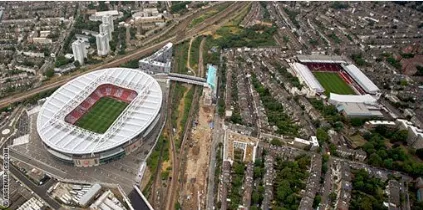
Once the proud symbols of world football, stadiums like Highbury are slowly fading from the memories of fans. Many famous football stadiums, once vibrant with endless cheers, are now just memories. The glory of the past cannot save them from decay, ruin, or being replaced by urban development. The names that once captivated the world now only live on in the nostalgia of fans. Let’s explore their current fate.
The Tragedy of Legendary Stadiums
Many stadiums that were once the heart of famous clubs have quietly closed their gates. The cheers and chants that once filled the air have dissolved into silence, making way for modern constructions and the new needs of society and modern football.
Highbury – A Memory Turned into a Residential Area
Highbury was a symbol deeply connected with the Arsenal Football Club. With nearly 100 years of history, it witnessed countless glorious moments for the North London team. However, in 2006, the stadium officially ceased operations when Arsenal moved to the Emirates Stadium, a new, larger-capacity ground. The old Highbury site was then redeveloped into a luxury residential complex called Highbury Square. While it has a new form, the site retains old architectural elements like the facade and the clock tower, serving as a reminder of its storied past.
San Siro – Fading Beauty Before Its Demolition
San Siro, or Giuseppe Meazza, is one of the most iconic stadiums in European football. As the shared home of AC Milan and Inter Milan, it has hosted many major UEFA and World Cup matches. However, in recent years, maintaining the San Siro has become expensive. The two clubs have planned to build a new, more modern stadium. Despite much controversy and opposition from fans, the prospect of San Siro’s demolition is slowly becoming a reality.
See more: https://www.outsideprague.com/top-ghi-ban/
Vicente Calderón – A Piece of Atletico Madrid’s Soul
Vicente Calderón was once the pride of Atletico Madrid. Located by the Manzanares River, it was home to the club from 1966 to 2017. After Atletico moved to the Wanda Metropolitano, the Calderón was completely demolished to make way for new roads and residential areas. The sight of a glorious stadium slowly turning into a pile of rubble and then disappearing entirely left many fans with a sense of loss.
Heysel – A Sad Memory for European Football
The Heysel Stadium in Belgium once hosted many major football events. However, a tragic accident in 1985 during the European Cup final between Liverpool and Juventus resulted in 39 deaths. After the disaster, the stadium was heavily criticized and was eventually torn down and rebuilt as the King Baudouin Stadium. Despite the new name and appearance, the painful memories of Heysel remain etched in the minds of football lovers.
From Roaring Crowds to Abandonment
It is no coincidence that many old stadiums have been retired. Behind this trend is a series of modern-day reasons, from economic demands to the standards of urban development and modern football.
The Rise of Economics and Urbanization
As cities grow and land values increase, old stadiums often occupy valuable real estate. Redeveloping these sites into residential, commercial, or office complexes is often seen as a more profitable option.
New Technology and Modern Standards “Killing” the Old Stadiums
Today’s spectators no longer just need a seat to watch football. They expect a complete experience with high-quality sound, lighting, Wi-Fi connectivity, and other amenities. Old stadiums with traditional designs cannot meet modern broadcasting standards or safety regulations, forcing them to give way to smarter, more multi-functional stadiums.
Are Historical and Emotional Values “Sold Short”?
The demolition of legendary stadiums is always met with a wave of opposition from fans. They see these places not just as venues for matches but as cultural symbols, tied to the club’s history and their own personal memories. The plan to demolish San Siro, even though it is still functional, shows that collective emotions and memories are sometimes not the top priority in development decisions.
Conclusion
The disappearance of legendary stadiums is an inevitable part of the modernization of football. While time may wash away old walls and roofs, the memories of a golden era live on in the hearts of fans—preserved through every televised moment, where Xoilac TV https://www.outsideprague.com/ continues to be a point of connection between football and its past.